
We are pleased to announce that we have released Terrain Analysis Package (TAP™) 7.7.5, featuring the new Two-Way Microwave Link Budget capability, accessible as part of the Microwave Reliability module. The new link budget implements the methods of ANSI/TIA-10-A-2023, and can be found in the Path Analysis group, on the Path ribbon bar. As with all other components in TAP™, the embedded Help includes extensive information on this new capability. The online TAP™ FAQs have also been updated.
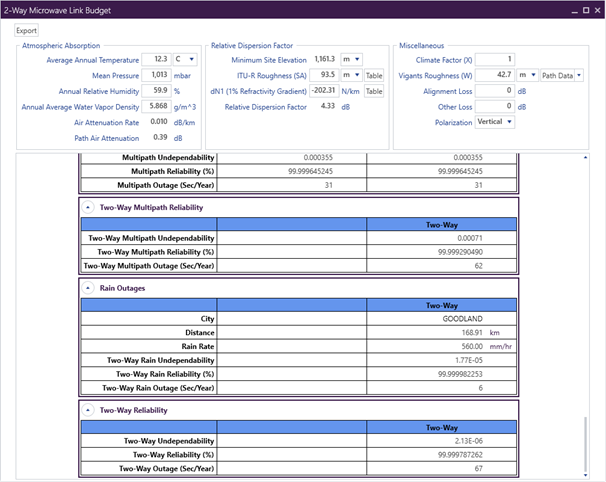
Two-Way Microwave Link Budget features include:
Consideration of Both Outbound and Inbound Paths:
Unlike the legacy one-way link budget (which is still supported), the two-way link budget considers both link directions for the current path study (left-to-right and right-to-left). In your path study, be sure to set the RX parameters for the facility on the left side and the TX parameters for the facility on the right side, as these will each be used in the calculations.
Reliability and Outage Calculations
Like the legacy one-way link budget, reliability and outage are calculated from the methods of Lenkurt (which incorporates the calculations from Vigants and Barnett), commonly referred to as the “North American” method. Separate calculations are performed for both the outbound and inbound directions, then the outages are summed. The underlying calculations are only accurate for a line-of-sight and Fresnel zone clear of obstructions, so both directions are checked for obstructions when the link budget opens. If there is an obstruction, it is noted, in red, in the Miscellaneous pane at the top of the dialog.
Climate Databases:
TAP™ 7.7.5 incorporates climate databases for use in the calculations, including: (1) Average Annual Temperature, Annual Average Water Vapor Density, ITU-R Terrain Roughness, and 1% Refractivity Gradient over North America; and (2) a database of rain distributions for 283 cities spanning North America.
Rain Fade Calculations:
In the legacy reliability calculations, a rain fade loss is applied prior to performing the reliability and outage calculations. In the two-way method, multipath and rain fades are treated as uncorrelated; multipath fading outages are calculated without first applying a rain loss. The Crane model is used to calculate the rain rate that corresponds to the calculated fade margin. TAP determines the closest city in the local rain rate database and that city’s rain rate data is used to determine the outage rate corresponding to the calculated rain rate. The multipath and rain outages are then summed to determine the total predicted outage.